What is Childcare? A Complete Guide for New Parents
You’re due back at work in a few months with parental leave nearly over, and suddenly you’re staring at a list of local childcare options with no clear sense of how to compare them. The names all sound warm and reassuring, the websites all show smiling children, and yet the decisions feel enormous. What type of care does your child need? What does quality look like? And how do you know a centre is safe and the right fit for your child?
Choosing childcare is a big decision that new parents face. This guide covers the types of childcare available in Australia, what genuinely good early childhood education looks like in practice, how to evaluate and compare centres, and how to apply for the Child Care Subsidy. Providers like Nido Early School represent what premium early childhood education can look like, and understanding that standard gives you a meaningful benchmark as you search.

The main types of childcare and what sets them apart
Families have several care options to choose from, and each suits different circumstances. The right fit depends on your child’s age, your working hours, and what kind of environment helps your child settle and learn. Understanding the differences between each option is the first step toward a decision you feel confident in.
Long day care and centre-based daycare
Long day care centres operate for extended hours, typically eight or more hours per day on weekdays, and serve children from infancy through preschool age. They employ qualified early childhood educators, follow a structured curriculum learning framework, and provide consistent, reliable care that suits most working families. Because children spend significant time in these environments, the quality of the space, the educational approach, and the educator experience are a fundamental part of children’s developmental progress. Quality long day care centres employ extensive educational programs for children from a few weeks old through to school age. These incorporate play-based learning, language development, and social skills and for preschool and kindergarten aged children, school readiness. They hold regular parent-teacher interviews to talk through your child’s progress, milestones and achievements.
Preschool programs and kindergarten
Preschool typically operates part-day or part-week for children aged three to five. They finish around 3pm and have structured programs to help children develop confidence and school readiness.
Family day care
Family day care is educator-led care provided in a registered home environment. Under the National Quality Framework, family day care services may care for up to seven children in total, with no more than four children of preschool age or under, though individual state regulations may set lower limits.

What quality childcare looks like in practice
Meeting minimum licensing requirements and delivering genuinely enriching early childhood education are two very different things. The gap between them is where most parents struggle to make clear comparisons. Understanding what separates a compliant centre from a genuinely exceptional one helps you look past brochure language and ask better questions on tour.
A clear educational philosophy, not just supervised play
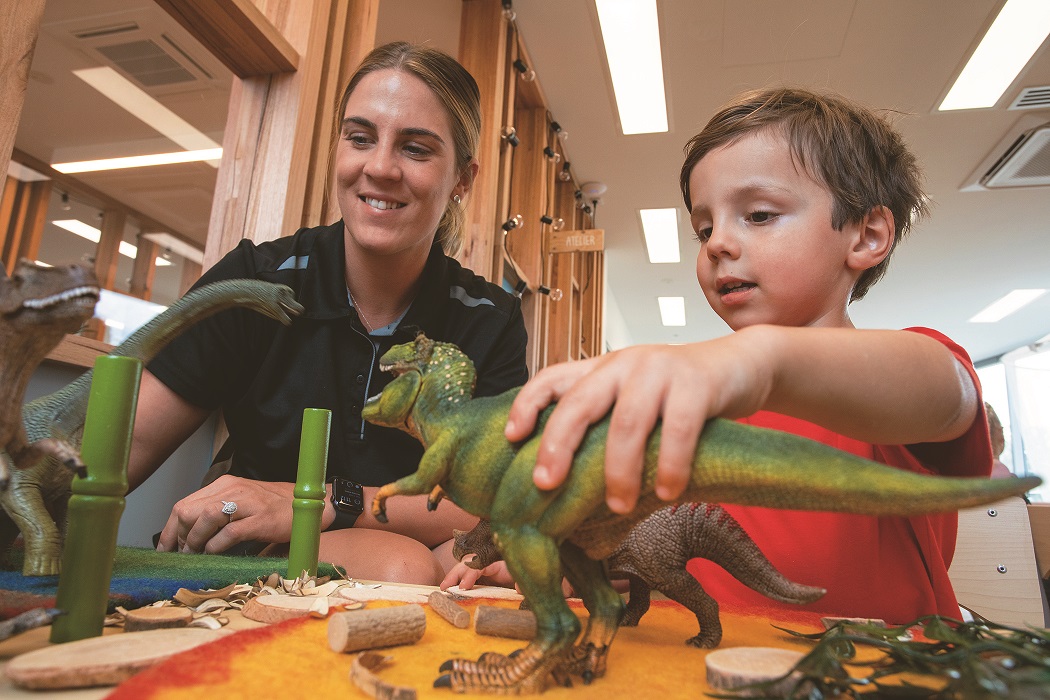
Quality centres operate from a coherent philosophy of how children learn, not just a schedule of activities that fills the day. The Reggio Emilia philosophy is one of the most respected in early childhood education globally. It treats children as capable, curious learners and structures the environment around their interests. In practice, this means child-led projects that evolve over days or weeks, ateliers (dedicated creative studios where children investigate through art, building, and materials), and educators who observe and document rather than direct. Centres that draw on this approach shape everything from the physical design of their rooms to how educators plan provocations and share learning stories with families, and Nido Early School is one example of such a provider.
Nutrition as part of the curriculum
What a child eats during their care day has a direct impact on concentration, growth, and their relationship with food. The best childcare providers treat nutrition as part of the educational experience, offering menus built around whole foods, often prepared on-site. At Nido Early School, cooking and eating are woven into the learning day: mealtimes are social, unhurried, and designed to build healthy food relationships alongside good nutrition. When evaluating any centre, ask specifically who designs the menu, whether meals are prepared fresh, and how dietary needs and allergies are managed.
Environments designed to invite exploration
Purposefully designed spaces signal genuine investment in the educational experience. Ateliers, outdoor adventure areas, and piazza-style gathering spaces are not aesthetic extras; they shape how children interact with materials, how educators facilitate discovery, and how much agency children feel in their own learning. Research into the relationship between physical environment and child outcomes is reflected in the National Quality Standard’s explicit criteria around learning environments. A centre that has made deliberate choices about space is likely applying the same intentionality to everything else in the program.

How to evaluate a centre before you enrol
Visiting a centre is essential, but knowing what to look for makes that visit genuinely useful. Most parents focus on first impressions, how the space looks, whether children seem happy, but the most revealing details are often in the answers to specific questions. Use these four areas as your framework when touring and comparing childcare services.
Staff qualifications and educator-to-child ratios
Under Australia’s National Quality Framework, these are the legal minimum ratios per state (source: ACECQA)
| Age of children | Educator to child ratio | Application |
| Birth to 24 months | 1:4 | All States and Territories |
| 24 to 36 months | 1:5 | All states except Victoria. |
| 24 to 36 months | 1:4 | Victoria |
| 36 months to Preschool age | 1:11 | ACT, NT, QLD, SA, VIC |
| 36 months to Preschool age | 1:10 | NSW & WA |
| 36 months to Preschool age | 1:10 2:25 for children attending a preschool program |
TAS |
| Over Preschool age | 1:15 | NT, QLD, SA, TAS, VIC, NSW |
| Over Preschool age | 1:11 | ACT |
| Over Preschool age | If no Kindergarten children present 1:10 for first 12 children then 1:13 |
WA |
Ask about background check requirements, CPR and first aid certification, and ongoing professional development.
Licensing, compliance history, and public records
Every approved childcare service in Australia has a National Quality Standard rating and a regulatory history that is publicly accessible. Check your state or territory’s regulatory register before committing.
You are entitled to ask a centre directly about their current NQS rating, any compliance notices received, and how they addressed them. A centre with nothing to hide will welcome the question.
Questions worth asking on every centre visit
The questions you ask during a tour reveal how a centre actually operates, not how it presents itself.
- How is my child’s day documented and shared with me?
- What is your approach when a child is unsettled during the settling-in period?
- Who designs your menus and how are dietary needs managed?
- What is your process when a safety incident occurs?
The quality of the answers, and the confidence with which they’re given, tells you a great deal about the culture of the centre.
Warning signs during a visit or settling-in period
Observable red flags include high staff turnover (ask directly how long the room educators have been at the centre), vague or deflecting answers to specific questions, no visible learning documentation or family communication materials, and hygiene standards that feel inconsistent. A centre that handles transparency well will display documentation, publish their compliance status, and communicate proactively. If you feel like you’re pulling information out of them, that tells you something important.

Child Care Subsidy: what it covers and how to claim it
The Child Care Subsidy (CCS) is income-tested and paid directly to approved childcare providers, reducing the fees families pay out of pocket. Understanding how it works, and what changed in January 2026, helps you accurately estimate your actual costs before you enrol.
Who is eligible and what the 3 Day Guarantee means
To be eligible, your child must be under 13, meet immunisation requirements for Family Tax Benefit Part A, and be enrolled with an approved care service. As of 5 January 2026, the activity test no longer applies to the first block of subsidised hours. All eligible families now receive at least 72 subsidised hours per fortnight (approximately three days per week) regardless of work or study activity. Families with more than 48 hours of recognised participation per fortnight, and families caring for Aboriginal and Torres Strait Islander children, receive up to 100 subsidised hours per fortnight.
The subsidy rate is income-tested: families earning up to $85,279 receive 90%, with the rate reducing by one percentage point for every $5,000 above that threshold, reaching zero at approximately $535,279. An annual cap on subsidy payments applies for some income bands, check the Services Australia CCS page for current figures, as these are updated periodically.
How to apply and what documents you’ll need
The application is completed through myGov via your Services Australia account. Before you apply, gather your proof of income, proof of residency, your child’s birth certificate, your employment or study details, and the enrolment information from your chosen provider. Once submitted, Services Australia will assess your eligibility and notify you of your subsidy rate and hours. Use a CCS calculator for a personalised estimate before you commit to any enrolment. Processing can take several weeks, so apply well before your intended start date, ideally as soon as your enrolment is confirmed.

Start your search with the right questions
Childcare, at its best, is not supervision. It’s a formative educational experience, one that shapes how a child connects with learning, with the people around them, and with their own sense of capability. The markers of quality are knowable and checkable. Visit centres in person, ask specific questions, comparing childcare services, and trust what you observe over what the website says.
Providers like Nido Early School bring together Reggio Emilia-inspired child-led learning, whole-food menus, purposefully designed environments, and transparent safety practices. That combination gives you a concrete benchmark for what quality early childhood education can look like, and a standard worth holding other centres to as you compare.
Use the framework in this guide on every visit. Work through the questions in the evaluation section. Check the regulatory register. And when you find a centre that answers your questions clearly, welcomes your scrutiny, and can show you the evidence behind their approach, that’s a place worth trusting.
Frequently asked questions about childcare
How do I find quality childcare services near me?
Do your research online for childcare services near you, walk around your local area, talk to friends and families and ask for recommendations. The Australian Government’s Starting Blocks website, lets you search for approved childcare providers by suburb or postcode. Once you have a shortlist of childcare centres in your area, cross-reference each one on your state or territory’s regulatory register to review their NQS rating and compliance history before booking a tour.
How do I apply for the Child Care Subsidy?
Apply through your myGov account linked to Services Australia. You’ll need proof of income, your child’s birth certificate, immunisation records, and enrolment details from your chosen provider. Apply as early as possible, as processing can take several weeks, and use a CCS calculator to estimate your subsidy before committing to a place.
How many hours of childcare per week is recommended?
There is no single recommended figure, and the research does not support a strict hour limit for healthy children in quality care. The evidence consistently shows that care quality matters more than duration.
What is the difference between long day care and family day care?
Long day care centres are purpose-built services that operate extended hours and employ multiple qualified educators across age-grouped rooms. Family day care is provided in an educator’s registered home, typically with smaller groups (up to seven children, with limits on the number of preschool-age children). Both are regulated under the National Quality Framework, but they offer different environments, centre-based care suits families needing reliable full-time hours, while family day care may appeal to those who prefer a home-like setting.
What should I look for when visiting a childcare centre?
Focus on staff stability, educator qualifications, the centre’s NQS rating, how the physical environment is designed, and how openly staff answer your questions. Ask specifically about their settling-in process, how incidents are managed, who designs their menus, and how they document and share your child’s learning. The confidence and transparency of the answers matter as much as the answers themselves.
Sources
- https://www.servicesaustralia.gov.au/who-can-get-child-care-subsidy?context=41186
- https://www.education.gov.au/early-childhood/providers/compliance-and-enforcement/enforcement-action-register
- https://headstart.gov/policy/45-cfr-chap-xiii/1302-91-staff-qualifications-competency-requirements
- https://pmc.ncbi.nlm.nih.gov/articles/PMC2938040/
- https://raisingchildren.net.au/grown-ups/work-child-care/organising-child-care/child-care-types
- https://www.vic.gov.au/types-child-care
- https://www.childcareestimator.com.au/guides/how-ccs-works